SMARTER ENERGY FOR SMARTER OPERATIONS

Lithium-ion forklift batteries and chargers

Unified battery and charger solutions engineered to reduce compatibility challenges and deliver dependable, seamless performance

Lithium-ion power, Yale precision

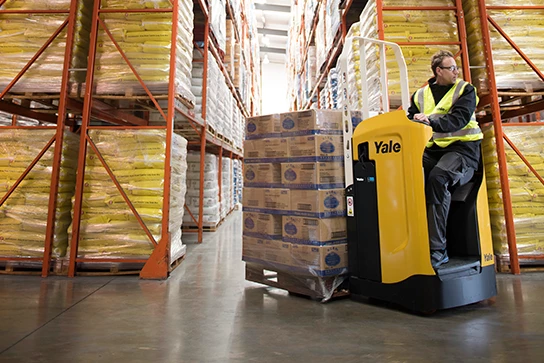
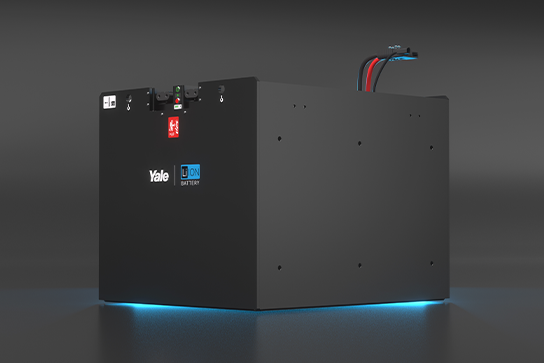
Specifically designed for Yale lift trucks, our lithium-ion batteries are high-performance, maintenance-free forklift power sources engineered to enable optimized power management and peak warehouse efficiency. Validated as a fully-integrated system with the lift truck and charger, this complete energy solution delivers exceptional reliability and performance — all with the one-stop shop convenience and expertise of the independent Yale® dealer network.

Advanced lithium-ion technology

The high energy density of Yale lithium-ion batteries supports long run times for fast-paced warehouses. The Lithium Iron Phosphate (LFP) chemistry at the core offers improved heat stability and tolerance, and longer life compared with other battery chemistries.
YALE-1569_Batteries-and-chargers-LP_Tabs-batteries.png

Compatible, connected chargers

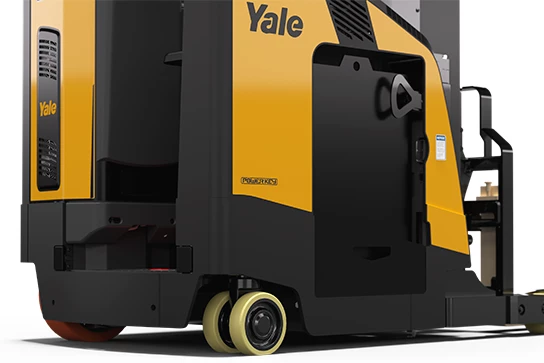
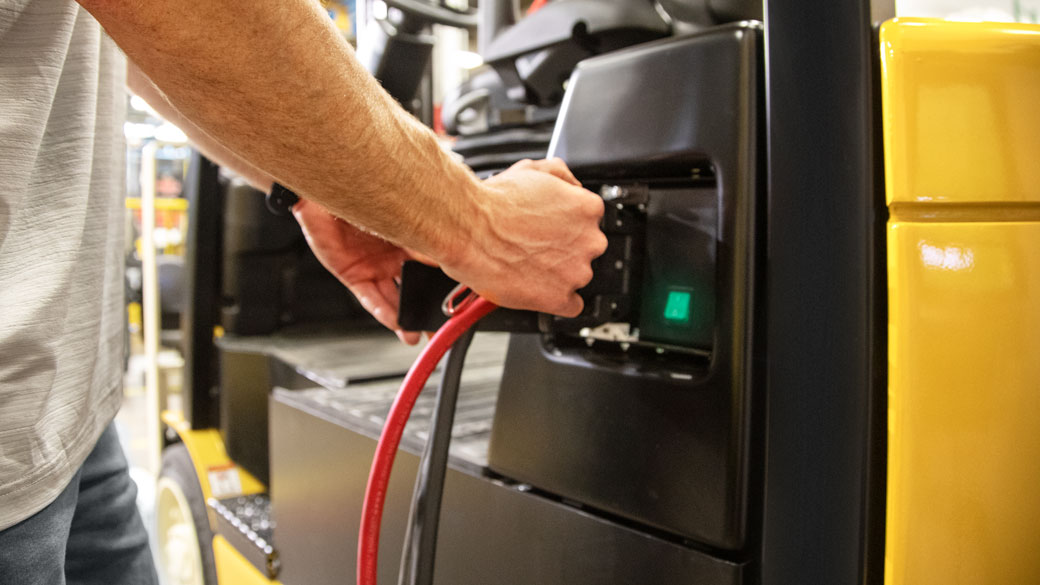
Unlike third-party lift truck battery solutions that mix and match components, our unified system eliminates battery-charger compatibility risks for a seamless, tightly integrated power solution. This system-level integration helps support communications between batteries and chargers directly with the lift truck, enabling early warnings and safety features. Easy-to-access external ports makes for simplified, operator-friendly charging.


Yale_lithium_ion_charging.jpg

TELEMETRY INTEGRATION

Efficiency in every charge

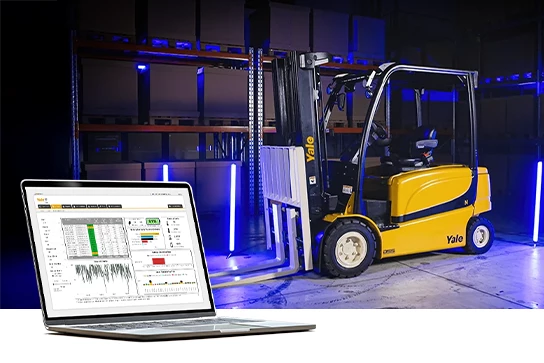
Yale Battery Vision telemetry is included with lift trucks factory fitted with Yale lithium-ion batteries, empowering fleet and service managers with access to real-time battery and lift truck data.

SPACE-SAVING DESIGN, FACTORY-FITTED CONVENIENCE

Space-saving design, factory-fitted convenience

Yale fully integrated lithium-ion lift trucks are not only manufactured with lithium-ion power, but are strategically designed around the smaller, lighter form factor of this advanced electric battery type. Engineering from the ground up rather than simply relying on a battery box replacement capitalizes on space savings, resulting in ergonomic and maneuverability advantages.

BROWSE INTEGRATED LI-ION MODELS

Yale electric lift trucks, powered your way

Choose the forklift battery technology that works best for your operation — lithium-ion, lead-acid or thin plate pure lead (TPPL) — available across our full line of Yale warehouse electric lift trucks.

Find your lift truck

YALE POWER KEY

Easily switch forklift battery types at any time

Gain the flexibility to change among battery types to suit your operation’s changing needs. Available on a broad lineup of Yale electric lift truck models, Yale Power Key™ is a one-of-a-kind solution that lets you switch among lead-acid, TPPL and lithium-ion batteries without any external accessories.

Fast-charging lithium-ion lift trucks for warehouse operations

Yale lithium-ion batteries and chargers FAQs

Battery performance

What is the expected performance of the battery?

The expected product performance of is comparable to the internal combustion engine equivalent, except it provides instantaneous power for forklift acceleration and lifting. In addition, the battery provides power silently as it performs its lifting and product placement tasks.


Can the battery be charged without unplugging it from the truck?

Yes, there are charge ports on the side of the battery for charging. These are available in single- or dual-charging configurations.


Is a secondary display required to show battery state of charge (SOC)?

No, the battery will communicate with the truck via the communication harness, and the SOC will be displayed on the truck display.

Battery composition and testing

What is the chemistry of the batteries?

LiFePO4 or Lithium Iron Phosphate (LFP).


What are the advantages of LFP chemistry vs. other chemistries, such as Nickel Manganese Cobalt (NMC)? Is this a proven technology?

LFP batteries are:

  • More stable and tolerant to heat
  • Lower cost
  • More eco-friendly — they don’t require mining of rare metals such as cobalt or nickel
  • Better suited against deep discharges
  • Can perform more charge/discharge cycles for longer life


How are the battery packs assembled?

The battery packs are assembled following carefully designed build processes to maintain the highest quality. Quality checks are completed at each step of the manufacturing process to fully comply with established quality standards. When battery packs have been completely assembled, an end-of-line test is performed to make sure battery packs comply with the test specifications.


What validation testing was performed on the battery?

Numerous validation tests were performed including drop, electromagnetic compatibility/electromagnetic interference (EMC/EMI), full operational temperature range, storage temperature, charge/discharge, fault and complete functional testing of all features.


Are the batteries ingress protection (IP) rated?

Yes. The batteries are IP54 rated.


Battery management system (BMS)

How does the BMS regulate charging and discharging?

The BMS continuously monitors cell voltage, battery module temperature, and the overall pack current to help the cells remain within their specified safe operation zone for voltage, temperature and current.


Charging cells at different speeds is a significant risk for lithium-ion batteries. How does Yale BMS mitigate this risk?

During the charge process, the BMS constantly monitors the cell voltage, battery module temperature and overall battery pack current. The BMS continuously communicates with the charger via CAN messaging to adjust the charge current to keep the cells within their specified safe operation zone. If, at any time, any cell approaches an unsafe operation limit during charging, the BMS opens the charge contactor to stop the charging process to keep the cell safe.

Battery-telemetry integration

Can the battery communicate with Yale Vision™ telemetry?

Yes. Battery information is collected by Yale Vision when equipped on the truck.


What battery information is available through Yale Battery Vision?

Yale Battery Vision displays information such as SOC, low SOC events, over/under temperature events, faults, energy consumption, usage versus charging time and lift lockout events.


Can telemetry warn of misuse?

Some telemetry parameters can be used to indicate misuse of the battery pack — specifically, repeated over-temperature faults and repeated discharge over-current faults.

Battery maintenance and service

What maintenance and care are required?

There is no maintenance required for the battery pack itself — simply follow proper operating procedures. The battery pack will take care of itself.


What is the battery warranty?

  • Guaranteed 75% state of health (SOH) for 60 months or 3,000 cycles or 10,000 hours (whichever comes first) if lifetime average battery temperature is less than or equal to 95 degrees Fahrenheit.
    • For example, battery would be replaced if:
      • SOH reaches below 75%, but hasn’t reached 60 months or 3,000 cycles or 10,000 hours and lifetime average battery temperature has remained under 95 F.
      • Issue with the battery we deem warrantable and battery SOH is above 75% and hasn’t reached 60 months or 3,000 cycles or 10,000 hours and lifetime average battery temperature has remained under 95 F.
    • After the battery reaches above 60 months or above 3,000 cycles or above 10,000 hours, the battery is out of warranty.
  • Guaranteed 75% SOH for 60 months or 2,500 cycles or 8,000 hours (whichever comes first), if lifetime average battery temperature is between 95 F and 113 F.
  • Guaranteed 75% SOH for 60 months or 2,000 cycles or 6,000 hours (whichever comes first), if lifetime average battery temperature is greater than, or equal to 113 F up to 140 F.


What are the storage requirements for the battery?

The battery pack should be stored in a dry environment within a 59 to 77 degrees Fahrenheit temperature range and less than 50% SOC to help maximize battery life.


How much does the battery self-discharge over time?

Less than 3.5% per month.


What is the expected life cycle of the battery?

The expected warranty life cycle of the battery is 3,000 charge/discharge cycles if operated at an internal battery temperature of 95 degrees Fahrenheit or less.


Can the Yale battery be refurbished, and how will this be done?

It is possible, following this procedure: Yale will determine if the battery pack can be refurbished after doing a check of each of the modules within the battery pack to determine the SOH spread between them. Based on those results, the refurbishment plan of action will be determined.


Who do I contact if there is an issue with the battery?

Contact your local Yale® dealer.

Charger features, performance and availability

What communication protocol is used between the battery and the charger?

Custom Yale CAN communication protocol is used between the battery and charger. Therefore, only the recommended chargers can currently be used with Yale lithium-ion batteries.


Can I use the same charger I already have for lead acid batteries?

No, lead-acid battery chargers cannot be used to charge Yale lithium-ion batteries. The chargers for Yale lithium-ion batteries cannot be used for lead-acid batteries, there is no charging profile for lead-acid batteries within the chargers.


Can I use the same charger I already have for lithium-ion batteries?

No, Yale lithium-ion batteries use a proprietary protocol with Yale chargers. Additionally, Yale batteries require a power signal from the charger, which many third-party chargers do not offer.


Are multi-volt output chargers available?

Chargers are initially set up for specific output voltages. There is a configurable key in the connector that determines which voltage will be used while charging. The cable assembly can be swapped to reconfigure the voltage setting.


Is dual-input charging available? How does dual charging work?

Yes. On certain models, you can use up to two chargers to charge a single battery. Dual charging must be equipped on the battery, and the battery will limit the total charge current allowed. Example: if charge current limit of the battery is 400 amps (A), but two chargers are plugged in at 300A each, the battery will only charge at 400A, not 600A.


Can an operator drive away from the charger if the battery is charging?

No, the operator is prevented from driving if the battery is charging.


Can I order a charger from the factory with the truck?

Yes, the charger can be ordered at the same time as the truck and delivered from the factory.

``

Charger testing and installation

How is a connection to the wall configured when the charger arrives?

For three-phase chargers, four wire flying leads are included. These must be connected by a licensed electrician.


How do I know what size breaker I need?

It depends on charger output voltage and amperage. Charger tech guides will indicate the required input current. Contact your local Yale dealer.

Charger warranty and maintenance

What is the charger warranty?

Warranty coverage extends up to two years.


What maintenance and care are required?

As long as the charger is installed in an appropriate environment as specified, minimal maintenance is required. Periodic inspections should be performed per the manual.


Who do I contact if there is an issue with the charger?

Contact your local Yale dealer.

YALE DEALER NETWORK

Global footprint. Local dealers.

Our worldwide network of skilled, dedicated dealers responds quickly and develops a deep understanding of your warehouse operation. Together with our dealers, we coordinate materials handling purchases and services across regions and countries and deliver the knowledge and expertise today’s warehouses need.

Let’s address your warehouse challenges — together

From battery selection and charger installation to warranty support and lifecycle management, our dealers are wholly focused on your warehouse’s success.

Contact your dealer